Here is a sample list of organizations who learned the hard way what the true costs of being in the “Cult of the Cloud” is all about, and decided to get out, save some money, and probably improve the availability and performance for everyone involved.
Contents
Example: Moz
You’ve probably never heard of them. Hell, I never heard of them till I read this article more than a decade ago. But the text of the article wasn’t what caught my eye, it was a very interesting table in the form of an image that was included that showed the company’s budget for three years running. This simple image told the story of Moz initially being in the “Cult of the Cloud”, their CEO finally realized reality and they started shifting gears. I say CEO, because I am friends with someone who knew this CEO and this exact situation, and was told the CEO was absolutely furious when they realized how much money was being wasted. I have no knowledge of what happened beyond the initial move out. But I wanted to just include that image directly here so it is easy to see. I put a link above to the actual article if you are curious.
25% of revenue going to cloud services
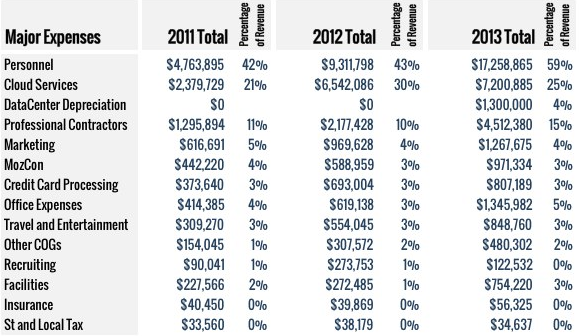
The text of the article mentions nothing about cloud anything. But you can see in the image, in 2011 they spent 2.7M in cloud, in 2012 they spent $6.5M(averaging $540,000/mo!), and they peaked in 2013 at $7.2M($600,000/mo!). The target of this blog is for organizations paying at least $50,000/mo, Moz was over 10X that!
This was a SMALL company, by 2013 they didn’t even have $30M in revenue yet, look how much they were spending! Obviously the CEO got the message as in 2013 there is a new line item for the data center.
A normal person might think this absurd cost is an outlier, but in my experience/opinion this is more the norm rather than outlier. As I documented in my “My cloud journey“, I worked for a company in 2010 who was also paying upwards of $500,000/mo to AWS for hosting services, and I’m pretty confident they didn’t even have close to $30M in revenue either, realistically probably not even $20M.
Example: DropBox
Moving 600 Petabytes out of cloud following eight year stint
This too is an old story, but quite a household name by contrast. I’m not aware of them ever releasing cost numbers, but here is an article I have referenced over the years. Dropbox was “born in the cloud”, specifically on AWS. When they moved out in 2015 they had roughly SIX HUNDRED PETABYTES of storage. Dropbox was apparently founded in 2007. So did it really take them EIGHT YEARS to realize how absurd the IaaS costs were?
No signs of urges to move back to cloud after a decade on prem
Seems like it. Here we are a decade after they moved out, they seem pretty happy as far as I know, and I have not read/heard any indications that they may want to go back.
I had a brief exchange with someone on LinkedIn and I raised Dropbox as an example of a big company that moved out of cloud a long time ago. I was confused at their response, they seemed to feel that was not a valid example because Dropbox wanted to be a cloud provider. Which wasn’t the point, the point was Dropbox was going to run their own infrastructure, not use hyperscale public cloud IaaS.
Example: Geico
This one is especially juicy because I was reminded of it maybe a week or two after I saw an absurd posting from some senior-type technical person from State Farm Insurance on LinkedIn(which I referenced on the homepage). He said something like “State farm can ONLY use public cloud because we want to focus on the business, not on servers”. Which is typical outsourcing BS. I mean almost any time especially a big company outsources to another company(say IT services), they often say this kind of thing. So I thought it was especially ironic/funny that this person would be using the same kind of lame excuse, as the situations really are not comparable (cost wise).
$300 Million cloud bill triggered a rethink
Here is an article about Geico, the title says it all
$300 million cloud bill triggered a rethink – and a shopping spree on modular hardware
thestack article
The article goes on to say Geico is a $40 billion per year company
Running 200,000 CPU cores on 30,000 VMs and containers on just one of their eight cloud providers, with 80% of their workloads in the cloud.
Then I get a subscribe pay wall so I had to stop, let’s go to another article about Geico here.
Costs rose by 2.5X, availability declined years into cloud journey
It talks about Geico started their cloud journey way back in 2013,
The ultimate result? Costs rose and availability declined. [..]Bills went up 2.5X
thestack article
So the obvious extrapolation here if their bill was $300M, and their costs went up 2.5X, I suck at math,but I think that means they should be able to do this “on prem” for $120M, saving $180M/year?
So, back to the State Farm example, say Geico really doesn’t want to deal with servers, they just want to “do business”. They could spin up a new independent business unit, for cloud operations, give it say $150M/year, then that business unit could do all of their hosting, and Geico could go about their business and pocket the savings. State Farm could do this as well, obviously that was the point of the comparison. How utterly clueless this person was making that kind of a statement, ignoring the costs at that scale is just ludicrous.
Example: SAP
SAP, the world’s largest Enterprise Resource Planning(ERP) software. Honestly I don’t even know what ERP does, other than some back office IT stuff. But I do know that it’s often times super complex, and SUPER expensive, and seems like almost every company after a certain size has to have ERP of some kind..
I don’t know when exactly it started, maybe January 2021 according to this article. I do know in recent years I have seen several articles regarding SAP pushing customers to SaaS versions of their products, going so far as to say I think at one point, if customers want to use “AI” with SAP, they have no choice but to move to cloud.
I believe I read at some point, perhaps more than one point, that SAP was/is leveraging hyperscale public clouds to host their SaaS applications on. Obviously if that is the case I believe that is a stupid idea for cost reasons and other reasons. But they were doing it anyway(assuming they were doing it that way…).
€20 Billion Euro investment for on premises
Fast forward to September 4, 2025, where this article talks about how SAP intends to spend 20 BILLION EUROS over the next decade building out data center footprints to host their own SaaS application stack.
So when I read that, average say 2 billion per year. How many millions if not hundreds of millions of euros/dollars were they burning each year hosting stuff on hyperscale clouds? Because to make a decision to spend TWENTY BILLION EUROS on one project that spans a decade is a serious commitment.
Example: 37 Signals
This is one of the best, if not best and most documented, and detailed move out of AWS that I am aware of. It is great how honest they were about the whole thing, especially the exact cost numbers. 37 Signals is not a big company, though they seem to be a decent amount bigger than the companies I have worked for. The company spent over a decade using cloud services before deciding to move out.
“We’ve run extensively in both Amazon’s cloud and Google’s cloud. We’ve run on bare virtual machines, we’ve run on Kubernetes. We’ve seen all the cloud has to offer, and tried most of it. It’s finally time to conclude: Renting computers is (mostly) a bad deal for medium-sized companies like ours with stable growth. The savings promised in reduced complexity never materialized. So we’re making our plans to leave.”
quote from the CEO of 37 Signals
“We’re paying over half a million dollars per year for database (RDS) and search (ES) services from Amazon. Yes, when you’re processing email for many tens of thousands of customers, there’s a lot of data to analyze and store, but this still strikes me as rather absurd. Do you know how many insanely beefy servers you could purchase on a budget of half a million dollars per year?”
quote from the CEO of 37 Signals
“Now the argument always goes: Sure, but you have to manage these machines! The cloud is so much simpler! The savings will all be there in labor costs! Except no. Anyone who thinks running a major service like HEY or Basecamp in the cloud is “simple” has clearly never tried. Some things are simpler, others more complex, but on the whole, I’ve yet to hear of organizations at our scale being able to materially shrink their operations team, just because they moved to the cloud.”
quote from the CEO of 37 Signals
“Look at it this way. We spent about half a million dollars buying two pallets of servers from Dell, which added a combined 4,000 vCPUs with 7,680 GB of RAM and 384TB of NVMe storage to our server capacity. This hardware was more than adequate to run all the heritage services we brought home, together with HEY, and give our other Basecamp operations a hardware refresh. And it was less than a third the cost of what we predict we’ll be saving EVERY YEAR! This is hardware we’ll be amortizing over five years.”
quote from the CEO of 37 signals
“Our collective cloud budget last year was $3.2m, and this was incredibly optimized, with long service commitments, scrupulous right-sizing and monitoring. There are lots of companies paying many times what we did for even less benefit.”
quote from the CEO of 37 signals
“We’re spending just shy of $1.5 million/year on AWS S3 at the moment to host files for Basecamp, HEY, and everything else. The only way we were able to get the pricing that low was by signing a four-year contract. That contract expires this summer, June 30, so that’s our departure date for the final leg of our cloud exit.”
quote from the CEO of 37 signals
37 Signals Blog Posts
Some links from the CEO’s blog (I haven’t personally read through all directly, though have read snips of them that he posted on LinkedIn as well as quotes in news articles below). There are a few more listed on this page.
- Why we’re leaving the cloud (Oct 19, 2022)
- We stand to save $7m over five years from our cloud exit (Feb 21, 2023)
- Five values guiding our cloud exit (Feb 22, 2023)
- De-cloud and de-k8s — bringing our apps back home (Mar 21, 2023)
- Cut cloud before payroll (Mar 23, 2023)
- The hardware we need for our cloud exit has arrived (Apr 6, 2023)
- Cloud exit pays off in performance too (May 22, 2023)
- We have left the cloud (June 23, 2023)
- Our cloud exit has already yielded $1m/year in savings (Sep 15, 2023)
- The Big Cloud Exit FAQ (Dec 19 2023)
- Keeping the lights on while leaving the cloud (Jan 7, 2024)
- Our cloud-exit savings will now top ten million over five years (Oct 17, 2024)
- It’s five grand a day to miss our S3 exit (Mar 26, 2025)
37 Signals News Articles
$3.2 Million bill that caused it to quit the cloud
Already Saved $1 Million
Staffing for on prem
There are probably more articles out there, I also saw their CEO post many times on LinkedIn, including on one occasion where he specifically addressed the question of staffing. He explicitly stated that there was no staffing changes made as a result of moving out of AWS. The same people that managed their cloud, were the same people that managed their data center presence. Which was true for my situation as well.
“The back of the napkin math is that we’ll save at least $1.5 million per year by owning our own hardware rather than renting it from Amazon. And crucially, we’ve been able to do this without changing the size of the operations team at all. Running our applications in the cloud just never provided the promised productivity gains to do with any smaller of a team anyway.”
quote from the CEO of 37 signals
I have gotten questions over the years many times, and seen many statements come across as facts saying along the lines of you need more staffing for on prem than you do cloud. When IMO, the situation is quite the opposite. You often need MORE expertise to operate in cloud than you do on prem. This is because many solutions on prem are driven to be more user friendly and scalable vs cloud is more API driven, and stuff(need a more developer like mindset). So it doesn’t surprise me that such folks that are used to operating in cloud, can adapt easier to on prem, because on prem is generally simpler.
But I can see almost in every situation where an organization moves TO public IaaS from on prem that they either need additional staff, or at the very least need to “skill up” on new things, as IaaS operates a totally different way from on prem. OR, don’t do either and try to operate things similar to on prem, while in the cloud and have even more costs and headaches as a result(ask me how I know..). I believe many organizations actually do the latter, at least initially.
Originally on prem
37 Signals was apparently founded in 1999. According to their CEO’s blog, they never fully left “on prem”, but instead leveraged cloud for well over a decade in large portions of their application stack with their newest application stack being entirely born in the cloud. Maybe they knew about the cost problems for a while and just ignored it hoping they’d figure it out in the end.
Example: LinkedIn
In June 2016 Microsoft announced it was acquiring LinkedIn for $26 Billion in it’s largest acquisition to-date.
LinkedIn plans to move to Microsoft Azure following acquisition by Microsoft
Fast forward to 2019, and LinkedIn announces it plans to move to public cloud, to Azure, which is owned by Microsoft as well of course.
“[..] That success, coupled with the opportunity to leverage the relationship we’ve built with Microsoft, made Azure the obvious choice. Moving to Azure will give us access to a wide array of hardware and software innovations, and unprecedented global scale. This will position us to focus on areas where we can deliver unique value to our members and customers. The cloud holds the future for us and we are confident that Azure is the right platform to build on for years to come.
Mohak Shroff (Senior Vice President of Engineering at LinkedIn)
Obviously I thought that was a stupid idea when I heard about it. Clearly this VP of engineering was influenced or even perhaps brought into the “Cult of the Cloud”, maybe from the Microsoft CEO himself.
LinkedIn abandons plans to move to Microsoft Azure
Fast forward to 2023, and LinkedIn says they have abandoned or at a minimum paused this migration to public cloud.
“[..] Over the past few years LinkedIn has deployed some services in Azure. In early 2022, the social network tapped up Azure FrontDoor, Microsoft’s content delivery network, which caches commonly accessed content across a global network of edge datacenters reducing the bandwidth and access latencies required to serve users.
[..]
As it turned out, while Azure’s scale may have presented a tantalizing opportunity at first blush, LinkedIn was having a hard time taking advantage of the cloud provider’s software. Sources told CNBC that issues arose when LinkedIn attempted to lift and shift its existing software tools to Azure rather than refactor them to run on the cloud provider’s ready made tools.
theregister.com article(link above)
I wanted to call out the quote for LinkedIn using “Azure FrontDoor”, in recent weeks I have on multiple occasions checked what CDN LinkedIn is using at least for www.linkedin.com, and it has consistently been CloudFlare.
Microsoft at least in recent weeks from my part of the internet has consistently been using Akamai by contrast(not Front Door). Unrelated, but in recent news, Microsoft had a sizable outage on their Front Door platform on Oct 29 2025. El Reg reports the outage lasting from 09:00 to 16:20 PDT, or more than seven hours of issues.
Example: Twitter
On the topic of social media, I do recall at some point, and I’m fairly confident it is still true today, that one of Twitter’s main data centers is the same one I am hosted out in Atlanta. I think someone told me a long time ago Twitter was there, and I do specifically recall seeing boxes addressed to them in the shipping area at one point. Though those data points are at least 6-7 years old.
Actually here is an article from 2013 saying exactly that.
Late last year, Twitter added about 100,000 square feet of space in a QTS (Quality Technology Services) facility in Atlanta, expanding a data center presence that it established in 2011.
datacenterknowledge.com
I moved into that QTS data center in November 2011.
Twitter pulling back from cloud following acquisition by Musk
There was an article on El Reg after Twitter was acquired by Musk and saying they were consolidating stuff (back to Atlanta?), pulling a lot out of cloud and closing a data center location in Sacramento, CA.
“[..]X “shutdown [sic] the Sacramento data center,” while at the same time “optimiz[ing its] use of cloud service providers and began doing much more on-prem,” the team said.”
theregister.com article
Example: Ahrefs
I had forgotten about this one, but I noticed it while looking through the LinkedIn posts of the CEO of 37 Signals trying to find a specific post of theirs.
Saving $400M by NOT going to the cloud
How Ahrefs Saved US$400M in 3 Years by NOT Going to the Cloud
Example: Grab
Saving $2.4M by moving Macs out of cloud
Grab is basically Uber in several asian countries. Recently there was an article regarding them moving out of the cloud at least for their Mac app development, and expects to save $2.4M over 3 years from running 200 Mac Minis in the cloud.
Example: Oracle
This is a different kind of example, but this has stuck in my head ever since I first read it, looks like nine years ago.
Oracle has always been well known for gouging their customers. Whether it is offering their premier database software on the “honor system” and going to audit customers and get tons of penalties out of them, or turning the Java platform into a software package that must be paid for(in some cases) and going after companies for that.
In the early days of cloud, Larry Ellison was very much against it, I don’t recall his reasoning at the time but he made a pretty large reversal of direction in 2016. His reason?
So it looks like our hardware business is slowing down, when in fact, it’s really not. We’re just going from selling hardware to renting hardware, and getting more money rateably over a long period of time. The business of selling hardware, that should stay flat-ish or get smaller as people move to the cloud. Software, that should stay flat-ish or get smaller as people move to the cloud. But our overall business, especially once we get through this transition, our overall business will grow very rapidly. And we’re going to be a much larger company, growing double-digits and more profitably than we were before.
Business Insider article quoting Larry Ellison CEO of Oracle
Think about that. The company that is more well known than pretty much any other for extracting money from customers was going all in on cloud because they believed they could extract even more money out of customers. That’s pretty chilling to me anyway.
Example: Meta
This is going off the path a bit, just a different kind of example.
Recently I was in a message thread on LinkedIn with someone who was pretty committed to cloud, and saying things like I haven’t worked in a big company, and cloud really shines when you get super big. I’ll happily admit all day long I have never worked for, nor want to work for big companies. But I said cloud makes even less sense at a larger scale as the economies of scale of doing it yourself skyrocket.
I used Meta as an example, an organization who is hyper scale themselves, but they are not a public cloud provider of any kind. So I asked them if cloud is so great, why doesn’t Meta shut down their data centers and move into Amazon/Google/etc? I also asked the same about Twitter as well at about the same time mentioning Twitter is hosted in the same data center as me(mentioned above). Their response sort of confused me, they said Meta/Twitter won’t do that because they don’t want to move to a competitor.
IMO neither Amazon nor Google really are real competitors for Meta/Twitter (barring Google’s past attempts at social media). I countered with, the competition angle is interesting and that exact point has always had me wondering why Netflix leverages Amazon cloud when Amazon Prime is such a big competitor to Netflix. Then I followed up with examples I mention here with SAP and Geico, being large companies that are moving out of public cloud.
They seemed to have run out of ideas on how to respond to my evidence, and simply stopped responding (after a couple days of engaging with me), more than a week later still no replies..